



From Uncertainty to Strategic Capital Allocation
Recent developments confirm that the global economy is not entering a phase of deterioration, but rather a new phase of capital reallocation. Geopolitical tension shifts in energy markets, the restructuring of trade flows, and evolving monetary policy dynamics are shaping an environment that requires strategic interpretation, not passive consumption of headlines.
Developments surrounding Iran and Ukraine represent key catalysts in this emerging phase. The persistence of tension in the Middle East, alongside ongoing diplomatic negotiations, creates a landscape of uncertainty that directly affects energy flows, global trade, and investment decisions. At the same time, the conflict in Ukraine is evolving into a prolonged geoeconomic event, influencing industrial production, defense spending, and transportation networks across regions.
Yet the true reading of these developments does not lie at the surface level of geopolitics. It lies in the capital flows forming beneath it.
Historically, every period of geopolitical tension has led to three structural outcomes:
first, an acceleration of investment in energy and infrastructure?
second, increased fiscal spending and industrial activity?
and third, the concentration of capital within the world’s strongest economy.
Today, the primary recipient of this capital remains the United States.
The U.S. continues to function as the core investment haven during periods of international uncertainty. It offers the deepest capital markets, the most advanced technological base, the largest energy complex, and unmatched liquidity. In times of global turbulence, capital does not exist in markets altogether. It reallocates toward the market capable of absorbing uncertainty and converting volatility into growth.
Recent market movements reflect precisely this shift. Despite geopolitical tensions, there has been no broad-based liquidation. Instead, a clear reallocation is underway. Technology and previously overextended segments have experienced selective corrections, while energy, transportation, industrials, and infrastructure are gradually strengthening. This represents the classic transition from uncertainty to repositioning.
A critical dimension of this period is the evolution of U.S. monetary policy. The recent release of lower inflation data, combined with the decline in U.S. Treasury yields, particularly the 10-year, has introduced a new framework for financial markets. The easing in yields signals that markets are beginning to begin to privacy in a cycle of monetary relaxation and the potential for more substantial interest rate reductions in the months ahead.
The deceleration of inflation is not merely a positive macroeconomic signal. It is a structural catalyst for the next investment phase. Lower 10-year yields reduce the cost of capital, support equity valuations, and create a more favorable backdrop for investment in growth, technology, and infrastructure. At the same time, they increase the probability of more pronounced rate cuts, which historically act as a powerful driver of subsequent equity market expansions.
In such an environment, the U.S. economy holds a structural advantage. The combined effect of geopolitical tension, elevated fiscal spending, and potential monetary easing creates a policy mix supportive of capital formation. Energy, defense, industrials, technology, and infrastructure stand at the center of this new phase.
The investment opportunity does not lie in avoiding volatility. It lies in understanding how volatility generates new valuations and new entry points. Periods of heightened uncertainty function as accumulation phases preceding major structural moves.
Today, we stand at such a juncture.
Geopolitical tensions are reshaping trade and energy flows.
Monetary policy is shifting toward accommodation.
Bond yields are moderating.
And capital is seeking allocation within markets that offer structural growth potential.
History demonstrates that the most significant returns are not generated when the outlook is entirely clear. They emerge when uncertainty forces capital to reposition before the next expansionary phase becomes evident.
This is not a temporary episode.
It is the beginning of a new investment phase.
Those who recognize that geopolitical tension and monetary easing operate in tandem as fuel for markets will be the ones shaping the returns of the coming years.
The next major move will not begin when the narrative turns fully optimistic.
It will begin while uncertainty remains elevated and liquidity gradually returns.
At this stage, the center of that liquidity is clearly the United States.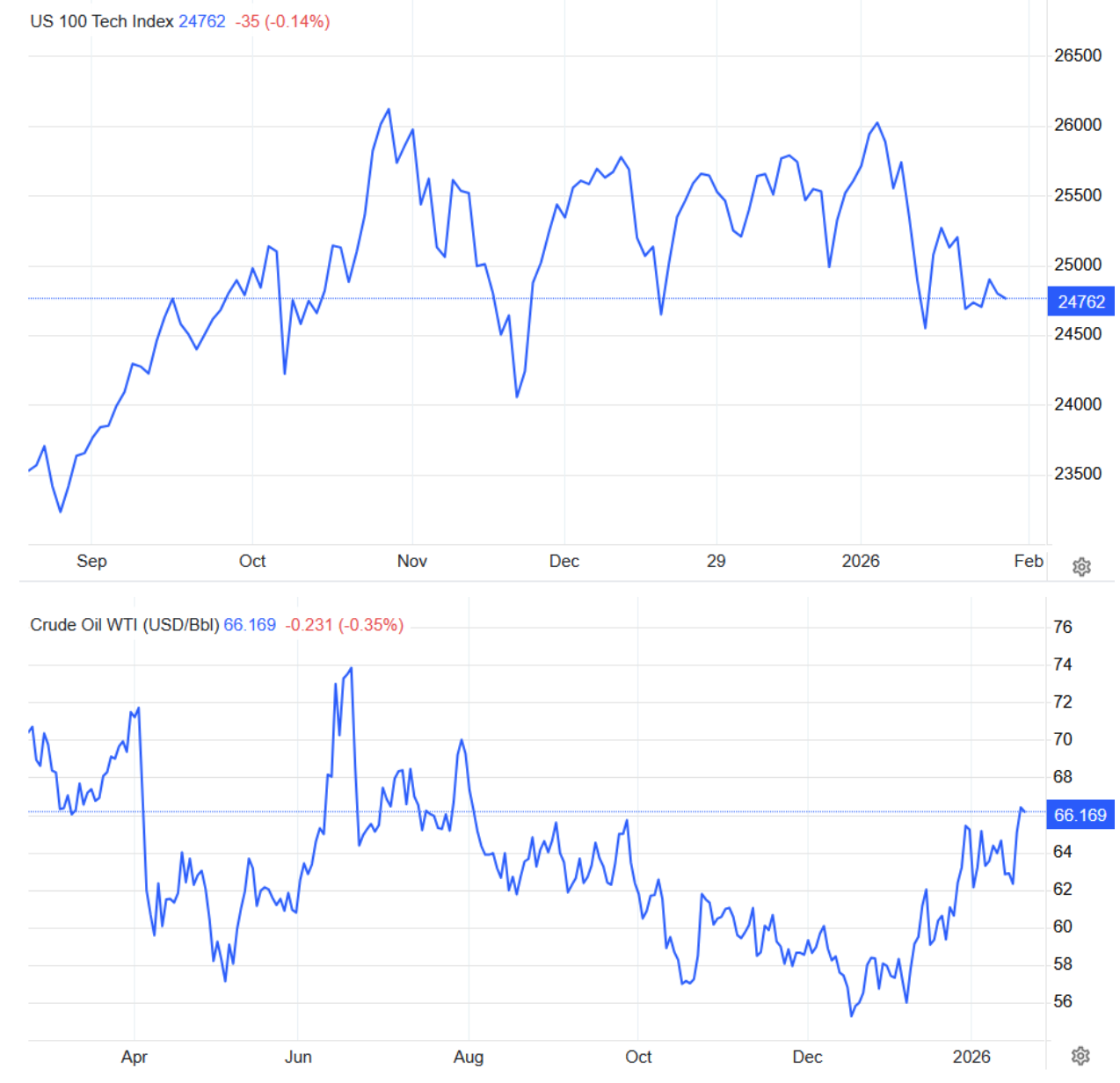
by Kotsiakis George