

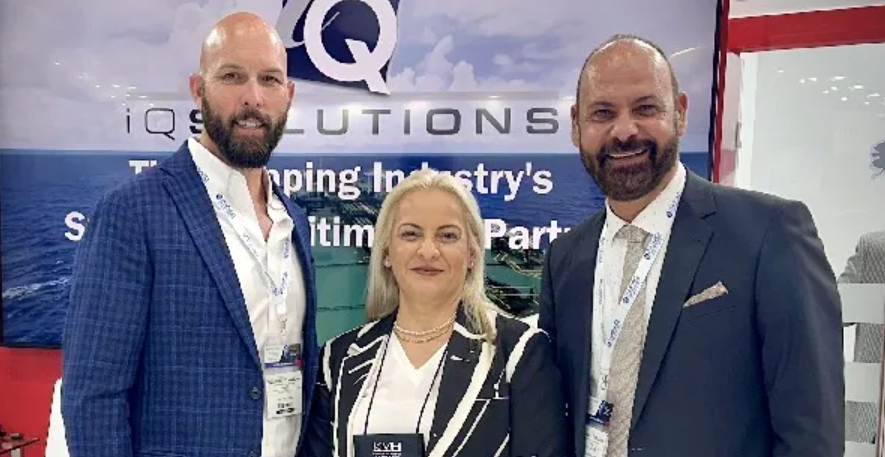
Interview between Adonis Violaris of CSN and Chad Impey SVP, Global Sales and Service and Zoe Morphitou Senior Sales Manager – Maritime, EMEA Mobile Connectivity Group KVH Industries, Inc.
Can you provide us an overview of KVH roles and contributions to the maritime industry, particularly in the realm of connectivity and digital solutions?
KVH provides a suite of connectivity solutions, harnessing the KVH ONE Network’s multi-orbit, multi-channel connectivity. Our network brings together GEO services using the high-throughput satellites in the Intelsat Flex maritime constellation, LEO services such as OneWeb and through Starlink, along with 5G/4G cellular and shore-based Wi-Fi. We connect all those together using our network management solution, CommBox Edge, which allows the IT managers to manage these different Wide Area Networks (WANs), control as many as 30 Local Area Networks (LANs) onboard, and give the crew Internet access. In addition, we support crew wellbeing and more using our content service, KVH Link, which delivers up-to-date news and entertainment to keep up morale.
You mentioned that you combined Starlink now with your own network, because you have your own network. It’s not like Marlink, for example, that they don’t have their own network. You have your own network. What is going to happen with the existing network? I mean, seeing now that you have Starlink as a major player in the market.
Well, our network is going to stay in place for the foreseeable future. Last year, we signed a three-year contract extension with Intelsat so we have a robust, reliable, and global VSAT network as the backbone of KVH ONE.
So, I think what you’re going to see in the market is that LEO services will increasing take on a primary communications role you’re going to continue to have a GEO-backup for the foreseeable future. It’s trusted, time-tested, and very robust to deliver SLAs and CIRs not necessatily available via LEO services. I think customers are beginning to understand that they need hybrid connectivity, and that’s what we’re really focusing on.
How has KVH’s approach to maritime connectivity evolved over the years and what trends are you currently observing in the industry?
There are lots of challenges these days because of the change, let’s say, of the way we’re working on board. Connectivity is very important. The demand is higher for bandwidth. And even the technology has changed over these years with the emergence of new LEO services, and the need to manage all of these services and the data.
What are the key challenges that maritime industry faces regarding connectivity and how is KVH addressing these challenges?
The main challenge now is just to have the correct connectivity on board. There are lots of options but we need to combine and give the best solution for the customers. So, how we address all those challenges is by getting the old technology, the new technology, combining all those together and having a more robust solution for our customers.
Can you discuss the importance of digitalisation in the maritime sector and how KVH solutions are facilitating this transformation?
I think what we’ve seen since we’ve entered into broadband communications is that there’s an insatiable appetite for connectivity and data whether it’s the crew or the onboard IT systems. We focus on providing the fastest speeds possible for our customers. With the advent of LEO services like Starlink and OneWeb, we’re able to deliver those faster speeds at lower costs than traditional services. This opens up a wide range of benefits and capabilities, for example to allow the crew to FaceTime home more often and to also help digitalise everything onboard the vessel, which is a very data hungry platform and part of a connected, global office.
How does KVH ensure the security and reliability of its connectivity solutions, especially in the face of increasing cyber threats?
Whichever network you’re looking at, there’s multiple layers of security. Whether it’s through VPNs, firewalls, or other services. Our multi-layer cyber program addresses the satellite networks, terrestrial networks, and more. But also there’s also a critical need for endpoint protection.
In addition to cybersecurity features built into our TracNet systems, our Combox Edge system offers layers of protection while we also partner with FortiGate, which is one of the leading cybersecurity appliance providers to deliver enterprise-grade security to help reduce cyber risks.
What role do you see satellite technology playing in the future of maritime connectivity and how is KVH positioning itself in this landscape?
Well, we try to always position ourselves with the best vendors, the best satellite operators as part of our comprehensive, integrated solutions. As Zoe mentioned earlier, there’s been a lot of changes in the landscape of the satellite industry, which a lot of consolidation between companies plus the arrival of new entrants. Starlink has changed the market for everybody. They provide a good service and there’s going to be new players coming in as well in the future. Our KVH ONE network is designed to be network-agnostic, enabling us to bring together existing and new services to meet a fleet’s diverse needs with a future-proof, end-to-end solution.
I heard something like 5G space, something like that. DO you know anything about this?
I’m not familiar with 5G space. So, we provide a 5G service, but our role is to partner with the best vendors possible to ensure that we’re delivering proper services for our customers and when Kuiper comes out in two years or so, I’m sure we’ll be having conversations with them as well.
Can you share any recent innovations or developments from KVH that are particularly exciting or impactful in the maritime industry? Or anything that is in the pipeline maybe?
I think the most recent one for us besides our LEO services is our crew content and our new CommBox Edge, which is a network and bandwidth management device.
Now that these IT managers have these high-speed connections, they really need to know how to manage them. Having Starlink is like driving a Ferrari with no steering wheel, no brakes. So now we are the brakes and the steering wheel to help manage that data.
We also look forward to expanding the delivery options for our outstanding KVH Link crew content service, which delivers movies, TV, music, daily news, and sports on board. This is very important for the crew that they are keeping up to date and they have a kind of entertainment and feeling like home.
Have you ever considered of providing this service to other satellite providers?
That’s a tough one from a technology standpoint because it was traditionally a multicast solution, broadcasting via our VSAT network to any KVH TracNet or TracPhone-equipped vessel.
We’re now moving toward the addition of over-the-air delivery, because we do have Starlink and all these other…
That’s actually the main point behind my question. Because you are already applying new satellite technologies into your own system, in your own platform. That’s why I said whether it’s possible that you expand to providing this beautiful crewing service of entertainment that you have, etc. to the rest of the satellite providers. Because I haven’t seen something like that running.
Absolutely, and we’ve very excited about it. Our linkHUB system is an onboard media server that received regular updates via secure flash drives delivered to the vessel. That was great for movies and TV but not sports, daily news, etc. The addition of a new over-the-air solution that we’ll be introducing in the next few weeks will enable daily delivery of content to linkHUB media servers around the globe via non-KVH satcom services, such as Starlink.
What are the future plans and visions for KVH in the context of the evolving maritime industry?
I think just listening to our customers, making sure we understand what the operational and IT side of the business needs, while also paying attention to crew morale will be vital.
Obviously, cybersecurity is going to continue to be part of it and making sure that we’re positioned to help our customers reduce cyber risks. As I said earlier, it’s also about making sure we partner with the right service providers and that we have the right products and solutions integrated together for both crew and operations. Our priority is to deliver first class service pre-sale, during deployment, and most importantly, post-sale to ensure our customers are always connected.
The message that we always get out is that KVH is always listening to the market’s needs and we will adapt based on new technologies, what the customer needs, and what’s the best service that we can give. Regardless of the size of the fleet and whatever. We don’t treat customers differently because they have one vessel or they have 100 vessels.
All our customers are very important to us and we want to give the best service, first class service to all of them.
COVID has managed to make us go a little bit faster in digitalisation of fleets and offices, especially in the Greek or Japanese market.
COVID really drove the acceleration of this process and proved the benefits, helping to make this breakthrough and push even the smaller ship owners to realize that they need to do something to remain competitive and efficient.
KVH: Leading Maritime Connectivity and Digital Solutions in the Age of Satellite Innovation
Typography
- Smaller Small Medium Big Bigger
- Default Helvetica Segoe Georgia Times
- Reading Mode