


China reinforced its global lead in shipbuilding and offshore engineering in the first half of 2026, with new orders for oceangoing vessels surging 105.2 percent year-on-year, while the value of new offshore engineering equipment orders more than doubled, giving Chinese companies over 80 percent of the global market share, official data showed.
Gross ocean product reached 5.5 trillion yuan ($815 billion) during the period, with its growth rate exceeding the 4.7-percent expansion in China’s GDP, state broadcaster CCTV News reported on Monday, citing preliminary estimates from the Ministry of Natural Resources.
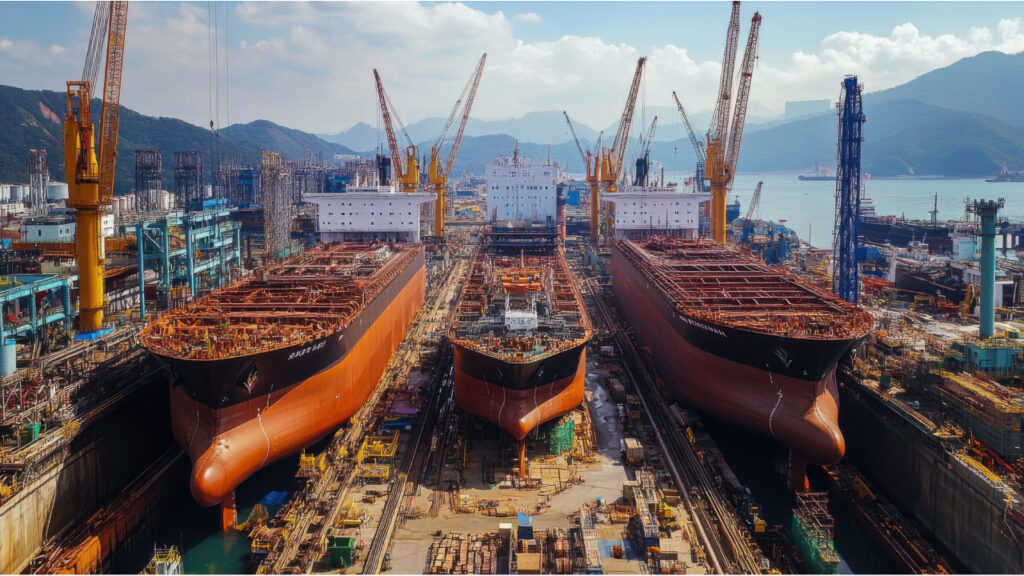
China’s traditional marine industries remained on a solid footing, with the shipbuilding sector extending its global lead across new orders, completions and orders on hand in the first half.
New orders for oceangoing vessels surged 105.2 percent year-on-year, while completions rose 34.8 percent and orders on hand increased 37.1 percent. China accounted for 73.9 percent of global new orders, 55.4 percent of completions and 63.3 percent of orders on hand, official data, cited by the Xinhua News Agency, said.
The value of China’s new offshore engineering orders jumped 121.9 percent in the first half, reinforcing the country’s leading global market position and highlighting its growing strength in high-value marine equipment manufacturing.
During the period, China delivered more than 40 vessels across major categories, including container ships with capacity exceeding 10,000 twenty-foot equivalent units (TEUs), massive crude oil carriers and large liquefied natural gas carriers. Many shipbuilders have full production schedules, with some order books extending beyond 2029, according to Xinhua.
“The marine economy’s growing competitiveness is an important sign of China’s progress from a major maritime country toward a strong maritime power,” Li Changan, a professor at the Academy of China Open Economy Studies at the University of International Business and Economics, told the Global Times on Monday.
The rise is increasingly visible in China’s order intake, the expanding size of its marine economy and the sector’s growing contribution to foreign trade volume, Li said. “These gains show that the marine economy is becoming an increasingly important part of China’s broader push to strengthen the national economy and cultivate new sources of growth,” Li added.
China’s shipbuilding sector is also accelerating its transition toward greener and smarter production, with a new generation of low-carbon vessels moving from design to commercial delivery. At the Mawei shipyard in Lianjiang, Fuzhou, East China’s Fujian Province, an intelligent liquefied natural gas (LNG) dual-fuel roll-on/roll-off vessel capable of carrying 4,200 vehicles is nearing delivery, according to CCTV News.
The vessel features an integrated smart energy system combining solar power, energy storage and shaft-generated electricity. It can also connect to shore power while berthed, enabling low-carbon operations throughout its voyages, the report said.
China also made notable advances in high-end offshore engineering equipment, including the delivery of Haiyang Shiyou 283, the country’s first mobile multi-purpose offshore intervention platform, and the start of installation of the Three Gorges Pilot, the world’s largest floating offshore wind platform by single-unit capacity, at 16 megawatts.
Li said the competitive strength of China’s shipbuilding industry no longer rested primarily on lower costs, in contrast to the sector’s earlier development.
“The advantage has expanded to cover the entire industrial chain, combining cost competitiveness with technological capability and broader supply-chain strength,” Li said. This comprehensive advantage is enabling Chinese companies to move into higher-value segments and assume a more important role in the global market, he noted.
Breakthroughs in deep-sea technology have meanwhile emerged as a core driver of innovation-led growth in the marine economy. At the Laoshan Laboratory in Qingdao, East China’s Shandong Province, the Wenhai 6000H deep-sea heavy-duty remotely operated vehicle is undergoing tests of its robotic arm as researchers make final preparations for an upcoming oceanographic expedition.
Financial support for the marine sector has also continued to expand. In the first half, 12 marine-related companies completed initial public offerings in China, raising a combined 13.34 billion yuan. Blue finance is increasingly channeling targeted funding across the industrial chain, from research and pilot testing to commercial production, providing sustained support for the high-quality development of the marine economy, CCTV News reported.
China’s 15th Five-Year Plan (2026-30) dedicates a full chapter to strengthening marine development, utilization and protection, calling for coordinated land-sea development, greater capacity to develop and manage the seas, and faster progress toward building China into a strong maritime power.
Looking ahead to the next five years, Li said that China’s extensive maritime development space and increasingly sophisticated industrial base would provide substantial room for growth, giving the sector an increasingly prominent place in China’s economic development.
Source: Global Times