


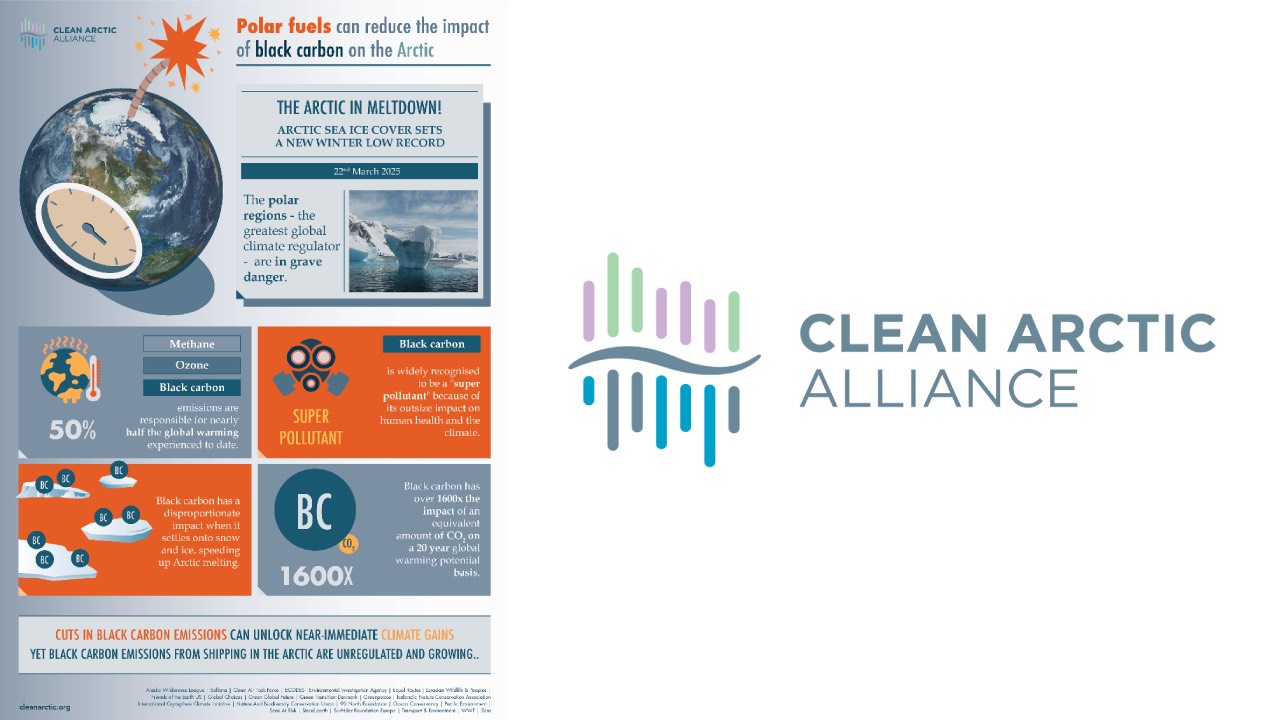
As a meeting of the International Maritime Organization’s (IMO) Pollution Prevention and Response committee opens (PPR 13, February 9-13), the Clean Arctic Alliance is calling for Arctic States to lead other IMO members in supporting a proposal to reduce black carbon emissions from international shipping in the Arctic.
A key paper submitted to the meeting (PPR 13-6), by Denmark, which represents Greenland at the International Maritime Organization, along with France, Germany and the Solomon Islands, proposes a new mandatory Arctic fuel measure for MARPOL Annex VI, requiring that ship s sailing in the Arctic use cleaner fuels with lowemissions of black carbon
“This week, IMO member states – especially Arctic countries – must show leadership on the Arctic fuel proposal, which sets out the characteristics of fuels that would be considered suitable for use in the Arctic – so-called polar fuels”, said Dr Sian Prior, Lead Advisor to the Clean Arctic Alliance. “After 15 years of consideration of cleaner fuels by the IMO, north Atlantic coastal nations must now take the lead, by supporting one another in the efforts to clean-up air polluting emissions from international shipping, and bringing other IMO member states on board.”
“This past December saw the lowest Arctic sea ice extent in the 47-year satellite record – melting of the Arctic sea ice results in loss of ice habitat, important for wildlife and Indigenous communities in the Arctic, while the melting of land-ice – glaciers – contributes to rising global sea-levels”, added Prior. “ Emissions of black carbon from shipping have a disproportionate impact in the Arctic, by contributing to the melt of sea and land-ice leading to global consequences. Black carbon emissions also increase the risk of respiratory and cardio-vascular illnesses in local communities”.
The Clean Arctic Alliance is calling on IMO Member States to support the PPR 13-6proposal in a working group at PPR 13, and subsequently forward it to the Marine Environment Protection Committee (MEPC 84 , April 27- May 1) for approval.
“The characteristics proposed to describe suitable fuels for use in the Arctic include fuel density, viscosity and carbon residue maxima to help limit sooting”, said Bill Hemmings, Black Carbon Advisor to the Clean Arctic Alliance. “Polar fuels will prevent the use of residual fuels or blends including heavy fuel oil (HFO) used by many ships worldwide today, often in conjunction with exhaust gas cleaning systems (scrubbers). As this would lead to the exclusive use of existing, widely available distillate fuels and new fuels, resulting in lower emissions of black carbon, it really is low-hanging fruit for the IMO.
Scrubbers
At PPR13, the Clean Arctic Alliance is calling on IMO member states to agree to develop a regulation in MARPOL Annex VI to facilitate restricting scrubbers (EGCS, or exhaust gas cleaning systems) in PSSA (Particularly Sensitive Sea Areas) by supporting the proposal in PPR 13/7/2 and to consider extending the scope to ECAs (Emission Control Areas) as proposed in PPR 13/7/3.
“During this week’s meeting, IMO member states must agree that scrubber discharge water seriously affects aquatic ecosystems and therefore agree that coastal states have the right to restrict or ban the discharge”, said Eelco Leemans, Technical Advisor to the Clean Arctic Alliance. “Scrubbers at present justify the continued use of heavy fuel oil (HFO), the dirtiest of all fuels. The shipping industry should get their act together by rapidly moving away from HFO and from fossil fuels in the longer term.”

Sewage
The Clean Arctic Alliance is calling on IMO member states to support stringent sampling and monitoring requirements for sewage treatment systems for existing ships as well as new builds, to ensure that they are fit for purpose, and support yearly review of all sewage treatment systems. See PPR 13/10/2: Revision of Marpol Annex Iv and Associated Guidelines – Comments on documents PPR 13/10, PPR 13/10/1 and PPR 13/INF.17.
“During this week’s meeting, IMO member states should prioritise taking action to address sewage from existing ships”, said Sarah Bobbe, Senior Manager, Arctic Program at Ocean Conservancy, a member of both the Clean Arctic Alliance.“Some member states do not want to be held accountable for having their existing ships discharge properly treated sewage, even despite a study from the Netherlands stating that 97 percent of ships are not compliant with current regulation. This has to change.”

Black Carbon Emissions in the Arctic
A new report by Energy and Environment Research Associates (EERA), commissioned by the Clean Arctic Alliance, Black Carbon Emissions from Ships in the Arctic 2019 – 2024, provides a comprehensive analysis of tank-to-wake Black Carbon (BC) emissions from Arctic shipping using three geographic definitions: a latitudinal band north of 60oN (excluding the Baltic Sea and Gulf of Alaska), the Polar Code Arctic waters, as well as a broader ecological boundary defined by the Arctic Monitoring and Assessment Programme (AMAP). It estimates BC emissions for the years 2019, 2022 and 2024.

The report examines the seasonal patterns of Arctic shipping routes, profiling ship characteristics, fuel consumption by EEZ and ship type as well as energy use. Historical estimates included in the report show how Arctic shipping activity and associated emissions have changed over time, while forecasts reveal how growth in emissions could affect the Arctic, and inform decisions on fuel choices.
Based on the report, it is clear that distillates are the dominant fuel choice in the Arctic. However, residual fuel use remains present and is increasing as ship traffic grows and receding sea ice opens new waterways. Arctic routes, including the Northern Sea Route (NSR) and North-West Passage (NWP), are seeing increasing traffic that passes through the Polar Code region, as such these activities will be captured when the Arctic HFO ban goes into effect. Full enforcement of the ban is not scheduled until 2029, and because its scope is limited to the Polar Code area, a considerable volume of traffic that affects the ecologically-defined Arctic region may still continue to utilize HFO. Norway’s Exclusive Economic Zone (EEZ) has the highest BC emissions within the 60°N and AMAP Arctic areas, but sees minimal reductions (≤ 2.1%) under the ban due to the Polar Code boundary’s limited reach.
Switching from HFO to lower-sulphur residual fuels (VLSFO, ULSFO) or distillate fuels/blends (MGO, MDO) reduces BC emissions, however switching to low sulphur residual fuels instead of distillates does not produce the same level of reductions. Even with full implementation of the HFO ban within the Polar Code region, the BC reductions remain limited due to already widespread use of distillate. Even under an optimistic assumption that all ships shift entirely to distillates, rather than low-sulphur residual fuels once the ban takes effect, this analysis finds a 2.4 to 5.0% decrease in total BC emissions, depending on geographical scope. Greater reductions in Arctic BC emissions could be achieved through stronger regulatory measures. While ship activity is increasing in the Polar Code region, the highest concentration of traffic falls within broader Arctic geographical scopes, along coastal areas with dense port activity, especially concentrated along Norway. Ship traffic is however growing throughout the Arctic region and associated Black Carbon emissions have grown by 47% in the five years from 2019 to 2024.
The geographic scope of the Arctic fuel measure proposed for inclusion in MARPOL Annex VI is yet to be decided. The scope is proposed to include waters north of 60oN latitude , which would also encompass all Polar Code Arctic waters. The Arctic Council’s AMAP or AHDR boundaries are possible alternatives, but it is important to recognise that restricting a measure to the same geographic scope as the Arctic HFO prohibition in MARPOL Annex I would not result in any beneficial outcome in terms of air pollution. The Clean Arctic Alliance has prepared more information on potential geographic scopes which is available in PPR 13/6/3.
In the Atlantic part of the Arctic, over 366,000MT of residual fuel use in 2024 was beyond the Polar Code Arctic waters. The largest share of residual fuel burn in the Atlantic Arctic was in the Norwegian Sea EEZ (over 70%), with 9.6% in Russia’s EEZ, 9% in Iceland’s EEZ, 6.5% in Greenland’s EEZ and 1% in the UK’s EEZ. It is also worth noting that the largest percentage of Arctic shipping is flagged to Norway with some 25% being international ships in its NIS registry. Most EU MRV shipping operating in the Arctic is expected to approach the Arctic via the North Sea meaning either a 60oN latitude geographic scope or an AMAP boundary geographic scope would include these ships.
The proposal in PPR 13/6 also resolves concerns around potentially catastrophic Arctic fuel spill cleanup due to low pour point of blended fuels, voiced by Norway and Iceland at previous sessions of PPR and MEPC.

About Black Carbon
Black carbon is a short-lived climate pollutant, produced by the incomplete burning of fossil fuels, with an impact more than sixteen hundred times that of CO2 over a 20 year period. It makes up around one-fifth of international shipping’s climate impact. Not only does it contribute to warming while in the atmosphere, black carbon accelerates melting if deposited onto snow and ice – hence it has a disproportionate impact when released in and near to the Arctic.
The melting snow and ice exposes darker areas of land and water and these dark patches then absorb further heat from the sun and the reflective capacity of the planet’s polar ice caps is severely reduced. More heat in the polar systems – results in increased melting. This is the loss of the albedo effect.
Declines in sea ice extent and volume are leading to a burgeoning social and environmental crisis in the Arctic, while cascading changes are impacting global climate and ocean circulation. Scientists have high confidence that processes are nearing points beyond which rapid and irreversible changes on the scale of multiple human generations are possible. Scientists say it is now too late to save summer Arctic sea ice, and research has shown that “preparations need to be made for the increased extreme weather across the northern hemisphere that is likely to occur as a result.”
Black carbon also has a negative impact on human health including premature death and harmful effects on the cardiovascular system (heart, blood and blood vessels), and recent research has found black carbon particles in the body tissues of foetuses, following inhalation by pregnant mothers.
The need to reduce emissions of black carbon because of both the climate andhealth impacts has been long recognised. On land, considerable effort has been made to ban dirtier fuels in power stations, to install diesel particulate filters on land-based transport, and to improve the burning of dry wood – all to reduce emissions of black carbon and improve air quality. However, at sea the same efforts have not yet been made.
Source: cyprusshippingnews.com