

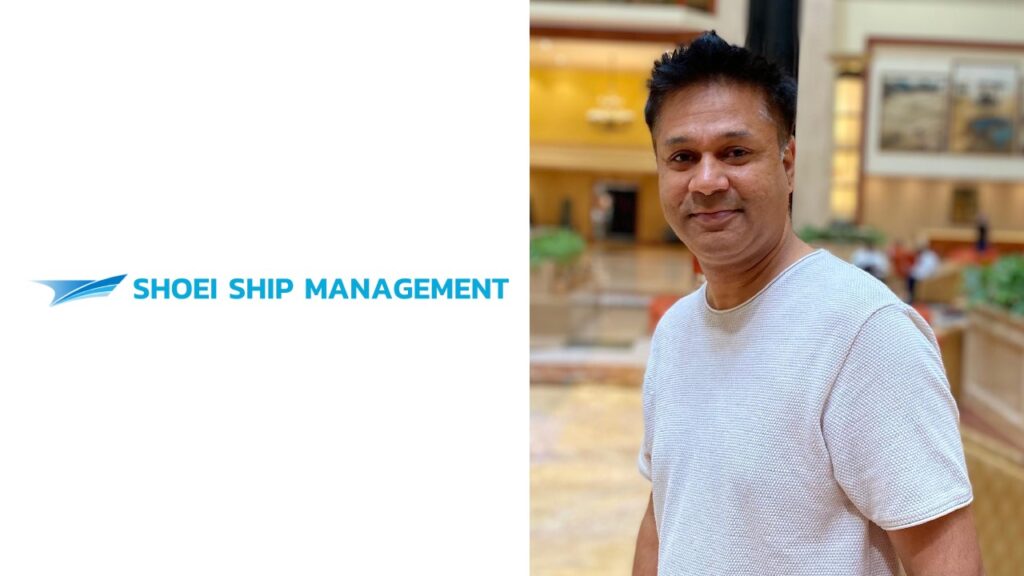
In an era where the maritime industry is grappling with rapid decarbonisation and a tightening global talent pool, the “human element” has moved from a boardroom buzzword to a critical operational pillar. Adonis Violaris of Cyprus Shipping News (CSN) sits down with Capt. Saurabh Kr. Singh, Marine Manager at Shoei Ship Management, to discuss how one of the industry’s most respected managers balances Japanese strategic precision with the practicalities of international crewing.
The Balance of Power: Commercial vs. Human Needs
Capt. Singh, you hold a unique vantage point in the industry. How do you balance the strict commercial and technical pressures of fleet operations with the human-centric needs of your seafarers?
It is a constant balancing act, but our philosophy is clear: safety-first decisions must take priority even when commercial pressure is at its peak. We make it a point to communicate the rationale behind these decisions to our commercial teams so that seafarer welfare is never sidelined.
To ensure this isn’t just rhetoric, we have embedded human-factor metrics, such as fatigue hours, rest quality, and retention rates, directly into our KPIs. Operational choices are influenced by crew wellbeing. Practically, this means holding cross-functional daily and weekly briefings between operations, technical, and crewing departments to align schedules and port calls with realistic manpower constraints.
Cultural Synergy: Imabari to the High Seas
Shoei operates within a traditionally Japanese ownership structure while managing an international crew. How do you bridge the cultural gap between the strategic expectations in Imabari and the realities for ratings on deck?
The key is translation, not just of language, but of intent. We take the strategic priorities from Imabari and translate them into culturally neutral Standard Operating Procedures (SOPs). We ensure that expectations are practical and demonstrated through onboarding modules, rather than just being documented in a manual. We also maintain tight feedback loops during inspections and crewing seminars, ensuring that the operational realities faced by our ratings reach decision-makers in Japan quickly and accurately.
The Future Fleet: Training for Toxicity
As the industry moves toward alternative fuels like methanol and ammonia, the safety burden on crewing is immense. How is Shoei adapting its training to prepare officers for these toxic or low-flashpoint environments?
We have completely restructured our training matrix. It’s no longer just about theory; it’s about immersion. This includes mandatory simulator scenarios, practical gas-handling drills, and full-scale emergency exercises before any deployment to such vessels. We are partnering with yards and chemical specialists to create shipboard mockups for confined-space simulations. Furthermore, we are updating our competency checklists to include specific PPE donning, leak isolation, and casualty management, all of which must be signed off by approved examiners every six to twelve months.
The Retention War: Keeping Top Talent
With the global officer shortfall hitting hard in 2026, how do you keep your top-tier Masters and Chief Engineers from migrating to competitors?
Retention is about more than just a paycheck. We offer defined career pathways that provide opportunities for technical and shore-management roles, alongside accelerated promotion tracks. Of course, we remain market-competitive with remuneration and long-term bonuses, but we also focus heavily on quality of life. This means reliable connectivity, improved food standards, and predictable leave cycles. By involving our senior officers in operational decisions, we boost their sense of ownership within the company.
The Connectivity Paradox: The Starlink Effect
High-speed broadband like Starlink is now the standard. Has this constant connectivity genuinely improved morale, or has it introduced new distractions?
It is a net positive, without a doubt. It reduces the “loneliness of the long-distance seafarer,” improves family contact, and makes e-reporting much more efficient. However, it does bring challenges regarding blurred work-life boundaries. We mitigate this with strict watchkeeping policies and education on digital discipline. It’s about teaching our crews how to manage connectivity rather than letting it manage them.
Mitigating Error: Beyond the Checklist
How has your approach to Bridge Resource Management (BRM) evolved to mitigate “single point of failure” human errors on your ultra-large vessels?
We’ve moved away from “checklist training” toward scenario-based BRM. We stress-test our teams with “degraded modes” scenarios where they face high traffic density compounded by engine or automation failures. These exercises include the entire bridge team and even shore-side operations to rehearse high-pressure decision-making. We emphasize non-technical skills like assertiveness and closed-loop communication to ensure there is always a redundancy in roles.
The New Vetting: Psychological Preparedness
With regimes like Rightship 3.2 moving toward conversational, competency-based vettings, how are you preparing your crews for that psychological pressure?
We are replacing rote learning with coached interview practice and role-play. We want our crews to be able to explain the reasoning behind a procedure, not just recite the procedure itself. We help them build evidence folders, succinct records of their work that they can cite during an interview. We also conduct mock vettings with external assessors to close any competency gaps before the real inspection takes place.
Back to Basics: The Essential Skill
Finally, when evaluating the cadets of today, what is the one traditional skill you insist they master before they rely on AI and digital systems?
Celestial and terrestrial situational awareness. I insist that they master practical chartwork and visual navigation, fixing positions by bearings and understanding instrument errors. In short, they must have the ability to make safe passage decisions using fundamentals. You have to understand the sea before you can trust the screen.
Source: cyprusshippingnews.com