


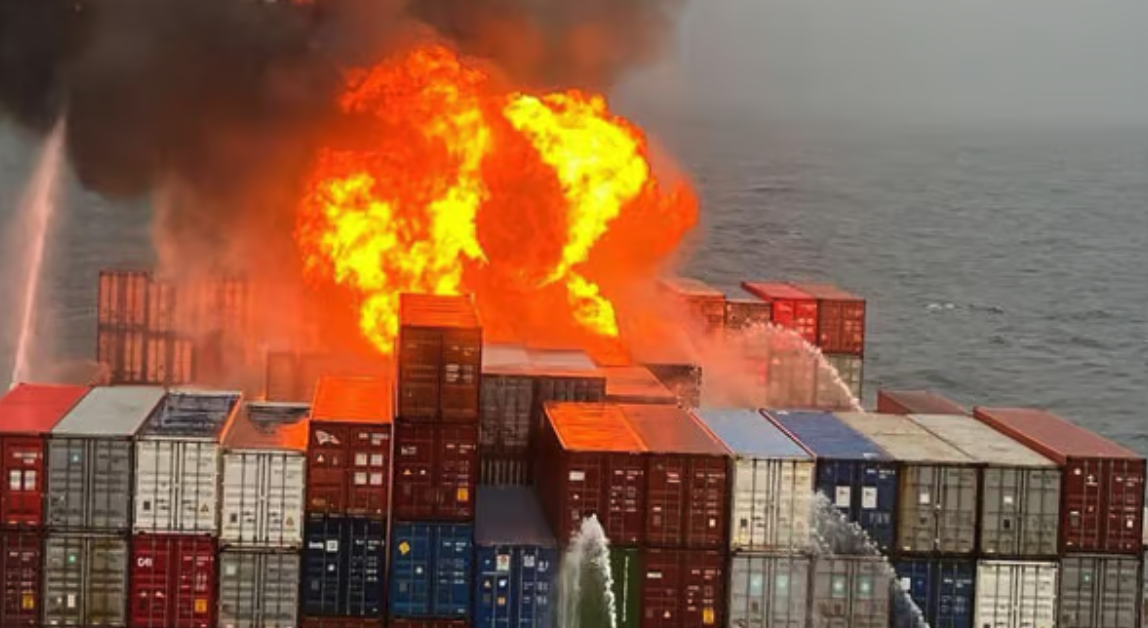
Two weeks after the fire began in the South Atlantic aboard the containership Espirito Santos Express, carriers are now advising customers that they expect “the vast majority of the cargo to be either severely damaged by the fire or a total loss.” This news comes as salvage teams are reported to be making progress with the fire as well as with another containership, HMM Platinum, which reported a fire around the same time.
Built in 2018 and owned by Seaspan Corporation, Espirito Santos Expres is a 11,800 TEU containership operating under charter to Hapag-Lloyd on a shared route with Ocean Network Express. The full details on the fire were not released by claims consultant WK Webster, who reports it was advised of fires and explosions aboard the vessel.
The 28-member crew evacuated the ship on October 15, approximately 975 nautical miles northwest of Tristan da Cunha. The crew was rescued by a passing bulker, but tragically, the chief officer of the bulker Aeolian Arrow was thrown overboard from the rescue boat, and the rescue boat was subsequently swamped and lost. Efforts to recover the officer were unsuccessful.
“In light of the severity of the incident and the extent of the reported fire damage, we wanted to share these developments with you without delay,” Hapag-Lloyd wrote in a customer advisory.
Both Hapag and ONE report that the owners, Seaspan, have advised them the fire remains under control. Reports said a team from SMIT had reached the drifting vessel, but as late as October 28, Webster was advising it understood the vessel was still ablaze.
The carriers are now writing that it “will take considerable time to bring the vessel into a port of refuge and assess the damage in more detail.”
There is no word on whether the fire started in the containers. Misdeclared and dangerous cargoes remain one of the biggest dangers to the vessel, but the fire could have also originated in the engine room or other locations on the vessel.
In a positive development for the other current containership fire, AIS signals show the HMM Platinum anchored off Durban over the weekend. This fire started around the end of September while the ship was navigating in a position off the southern coast of Lavanono, Madagascar. Built in 2013, the 63,000-dwt vessel was also bound for Brazil when the fire began. Reports indicate that there are approximately 2,300 TEU aboard.
HMM previously reported the fire had been controlled, working with a salvage team from SMIT. However, the vessel was delayed by weather and had moved away from South Africa while tugs remained with it as a precaution. The crew was reported to be safe, and the ship appears to be waiting for space in Durban so that it can complete its survey to determine the full extent of the damage.
Source: maritime-executive.com