


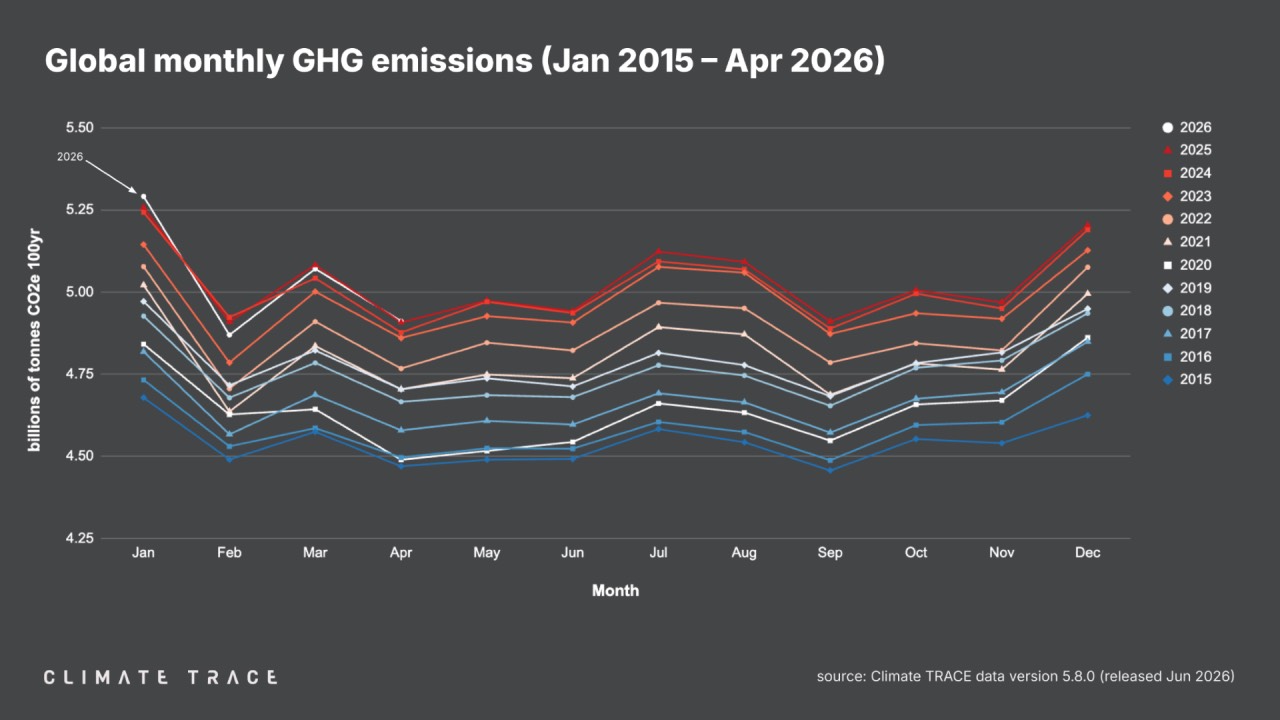


Of the other top five emitting countries:
-
United States emissions increased by 1.0 million tonnes CO₂e, or 0.2% year over year;
-
India emissions increased by 0.6 million tonnes CO₂e, or 0.2% year over year;
-
Russia emissions declined by 0.2 million tonnes CO₂e, or 0.1% year over year;
-
Indonesia emissions remain unchanged.


-
Agriculture emissions were 603.9 million tonnes CO₂e, unchanged vs. April 2025;
-
Buildings emissions were 308.5 million tonnes CO₂e, a 2.4% increase vs. April 2025;
-
Fluorinated gases emissions were 145.0 million tonnes CO₂e, unchanged vs. April 2025;
-
Fossil fuel operations emissions were 790.7 million tonnes CO₂e, a 0.1% decrease vs. April 2025;
-
Manufacturing emissions were 866.7 million tonnes CO₂e, a 0.7% decrease vs. April 2025;
-
Mineral extraction emissions were 17.4 million tonnes CO₂e, unchanged vs. April 2025;
-
Power emissions were 1,256.3 million tonnes CO₂e, a 0.8% increase vs. April 2025;
-
Transportation emissions were 753.3 million tonnes CO₂e, a 1.0% decrease vs. April 2025;
-
Waste emissions were 169.7 million tonnes CO₂e, a 0.7% increase vs. April 2025.
The urban areas with the greatest increases in absolute emissions in April 2026 as compared to April 2025 were Tehran, Iran; Chicago, United States; Opole, Poland; Butibori, India; and Mannheim, Germany. Those with the largest absolute emissions declines between this April and last April were Dubai, United Arab Emirates; Detroit, United States; Holland, United States; Newcastle, Australia; and Rotterdam [The Hague], Netherlands.
The urban areas with the greatest increases in emissions as a percentage of their total emissions were Butibori, India; Uruguaiana, Brazil; Mansa Nagar, India; Zenica, Bosnia and Herzegovina; and Opole, Poland. Those with the greatest decreases by percentage were Lufeng, China; Yenakiieve, Ukraine; Monclova, México; Mariupol, Ukraine; and Lueyang, China.
Source: cyprusshippingnews.com