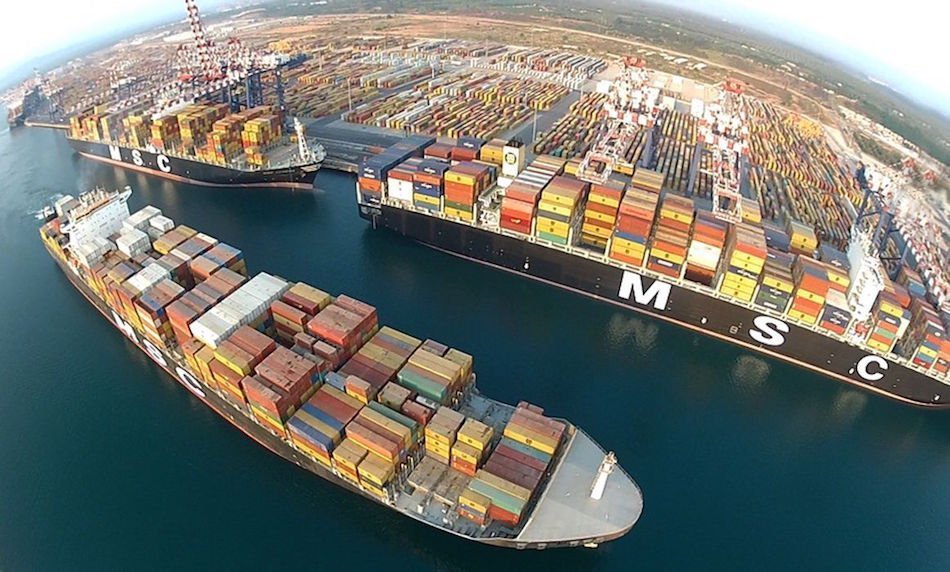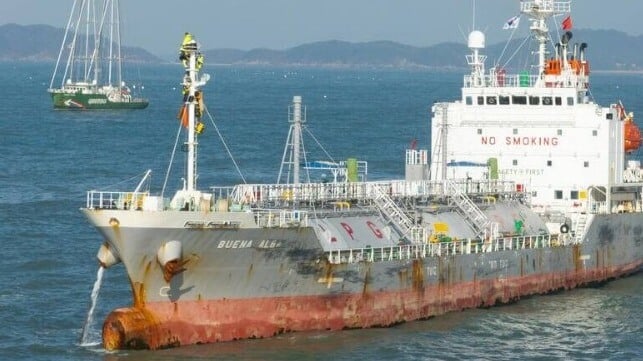




The Mediterranean is gradually returning to the center of the global economic and geopolitical map. For decades, Malta has understood something that markets often tend to forget geography matters. Located at the crossroads of Europe, North Africa and the Middle East, it is far more than a small island economy. It forms part of one of the world’s most important maritime corridors and has built a strong shipping ecosystem around this position, encompassing shipping, ship registration, financial and professional services, logistics and international business activities.
This is precisely why Malta is becoming particularly relevant at a time when shipping appears to be entering a different phase of the global investment cycle.The developments of 2026 have once again demonstrated that shipping cannot be analyzed independently of geopolitics, energy, interest rates and global trade. The Mediterranean, the Red Sea, the Strait of Hormuz and now the Arctic are not separate stories. They are all parts of the same strategic map.
And perhaps the most important question for investors today is not what has already happened. It is what comes next. Shipping may be approaching the point where the War Premium gradually begins to create the conditions for a Growth Premium. The distinction is critical.
During the first part of the year, a significant portion of the extreme movements in freight rates was driven by geopolitical disruption, changes in shipping routes, energy insecurity and constraints on available capacity. If, however, the next phase combines gradual geopolitical de-escalation with stronger global trade, infrastructure investment, energy demand and increased industrial activity, shipping could begin to benefit from a much broader economic cycle.
And the developments of this week could prove particularly important for that transition. New York at the Center of Geopolitics. The 81st United Nations General Assembly brings together nearly 130 heads of state and government in New York this week. The General Debate takes place from September 22 to 28, creating one of the most important diplomatic meeting points of the year. Under normal circumstances, another UN General Assembly would primarily be regarded as a major diplomatic event.
But in 2026, circumstances are anything but normal. Within the space of just a few days, New York will host political leaders directly connected to three of the year’s most important geopolitical fronts: Ukraine, Iran and Greenland. Donald Trump and Volodymyr Zelensky are expected to meet on the sidelines of the Assembly, at a time when the course of the war in Ukraine remains a critical factor for Europe, energy, raw materials and international markets.
At the same time, both Iranian President Masoud Pezeshkian and Foreign Minister Abbas Araghchi are expected to be in New York. The presence of the Iranian delegation is particularly significant precisely because it comes while the confrontation with the United States remains unresolved and the Strait of Hormuz continues to be under extreme pressure. This does not mean that agreements are automatically within reach. It does mean, however, that despite military conflict and hard rhetoric, diplomatic channels remain open. And for markets, this detail matters far more than it may initially appear.
Markets do not need every geopolitical problem to disappear. They need uncertainty to begin to become measurable. Greenland: Looking for the Strategy Behind the Rhetoric. Among the most important developments this week is the effort to establish a new framework between the United States, Denmark and Greenland. For us, this development carries particular significance.
Since the beginning of the year, both through our analyses and through our published articles, we had already highlighted the strategic importance of Greenland’s geographical position and the role it could play in the emerging balance of power in the Arctic. At the time, much of the public debate focused on Donald Trump’s particularly aggressive rhetoric and his references to an American presence and an American flag in Greenland. We had chosen to look beyond the rhetoric. Looking at the strategy.
Greenland is not simply a vast island with significant natural resources. Its geographical position lies at the heart of the Arctic’s growing importance for security, critical raw materials, energy and future maritime routes. The real strategic objective, therefore, did not necessarily have to be ownership of Greenland. An agreement that would secure an enhanced strategic presence and access for the United States in the region could achieve a significant part of the geopolitical objective without changing Greenland’s sovereignty.
And that is precisely what makes today’s developments so interesting. From the image of an American flag in Greenland, we are now moving toward the prospect of an agreement that could offer the United States something strategically more important than the symbolism of ownership: a stronger position in the Arctic and a greater role in the security and surveillance of a region through which increasingly important commercial and maritime flows could pass in the future.
At the same time, it is important to distinguish strategic analysis from confirmed facts. Denmark and Greenland have insisted on preserving Greenland’s sovereignty and territorial integrity, while the new framework is linked to a broader strengthening of Arctic security. This, however, does not diminish the strategic importance of development. On the contrary, it is consistent with a characteristic of Trump’s negotiating approach that we have repeatedly highlighted in both our analyses and our articles: the initial demand may be far greater than the outcome, but the outcome may still serve a broader strategic objective.
For shipping, this carries even greater significance. The Arctic, the Mediterranean, Suez and Hormuz may be located in different parts of the world, but they are increasingly becoming parts of the same strategic equation: who has a presence, who provides protection and who gains access to the maritime arteries through which energy, commodities and global trade will move over the coming decades. Iran and Hormuz: The Risk Remains. If Greenland today represents an example of a transition from confrontation toward negotiation, Iran stands on the other side of the equation. The Strait of Hormuz remains under severe pressure, while commercial traffic continues to be dramatically below normal levels. The latest figures show only 17 commercial vessels passing through the Strait during the most recent weekend, compared with 37 the previous week and approximately 125 large commercial vessels per day before the war.
This means that the geopolitical risk premium in energy and shipping has not disappeared. The presence of the Iranian leadership in New York this week, however, is particularly interesting.
We do not know whether it will lead to meaningful diplomatic progress. Nor does the physical presence of both sides in the same city, by itself, imply negotiations. But we do know something else. As long as diplomatic channels remain open, and as long as the economic cost of the conflict for energy and global trade remains so high, the possibility of diplomacy cannot be ignored by markets.
And any meaningful de-escalation involving Iran and the Strait of Hormuz could very quickly change the way geopolitical risk is priced across energy, shipping and global markets. The Next Quarter Could Change the Picture. Perhaps, therefore, the most important period for markets is not the one behind us, but the quarter that lies ahead.
If developments surrounding Greenland are accompanied over the coming months by meaningful progress on other geopolitical fronts, primarily Iran and, to a different extent, Ukraine, then the end of 2026 could find markets facing a very different environment from the one they are pricing today. The first area where this change could become visible is energy.
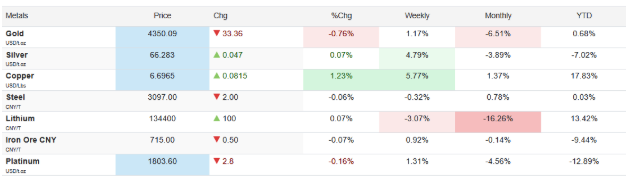
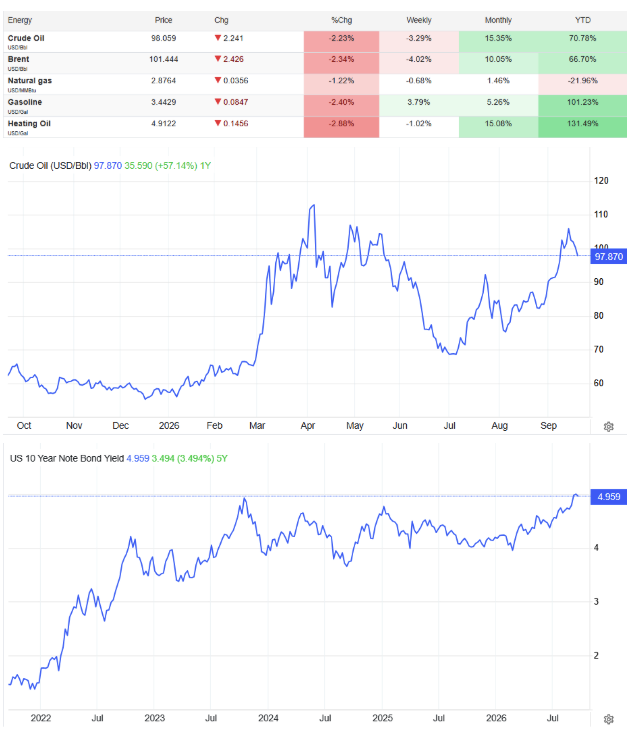
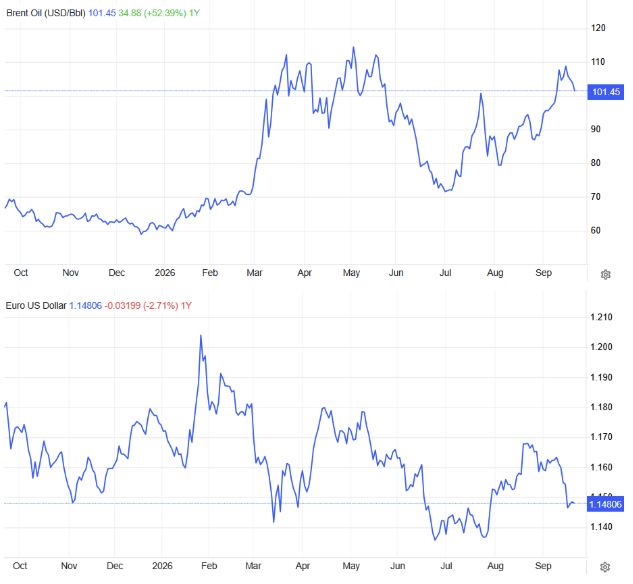
Current oil prices continue to incorporate a significant geopolitical risk premium because of the conflict with Iran and the uncertainty surrounding Middle Eastern energy flows. This is also where one of our key expectations for the next quarter lies. In a scenario of meaningful geopolitical de-escalation and a gradual normalization of energy flows, we believe oil could initially correct to below $80.
This is not a scenario based simply on supply and demand. It is primarily based on the possibility that a significant part of the geopolitical premium currently embedded in prices could be removed. And such a move would have implications extending far beyond the energy market itself. Oil below $80 could ease inflationary pressures, reduce energy costs for businesses and households, and improve real financial conditions across the U.S. economy.
Combined with a potential decline in long-term U.S. bond yields, this could create a very different mix for markets: lower energy costs, lower inflation expectations, reduced geopolitical uncertainty and better conditions for growth.
This could become a powerful catalyst for positive market momentum during the final quarter of the year. There is, however, a second dimension that cannot be ignored: the U.S. midterm elections. Energy, the cost of living, inflation and households’ broader perception of the economy are all issues that influence the political environment in the United States. Recent polls show that the economic and geopolitical environment remains politically challenging for Trump and the Republicans.
We do not know whether a potential de-escalation would translate into a specific electoral outcome. Voting decisions are shaped by many more factors. From a purely economic perspective, however, lower oil prices, lower inflation, lower bond yields and reduced geopolitical uncertainty would create a more favorable economic environment both for markets and for the day-to-day economic experience of American voters. And this is precisely where geopolitics and markets interact.
If the agreements and negotiations now beginning to take shape do indeed lead to a more stable international environment, then the final quarter of 2026 may no longer be about how large geopolitical premium markets need to pay. It may be about how quickly they begin to remove it.
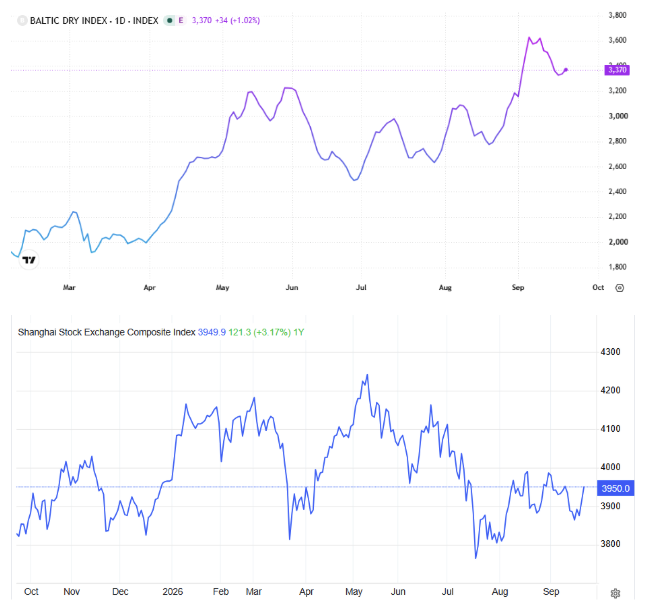
From War Premium to Growth Premium. This is where, in our view, the most important investment idea lies. Until now, a significant part of the strength in certain shipping markets has been driven by war, longer distances, the rerouting of traditional shipping lanes and energy insecurity. This is War Premium.
The truly significant change, however, will come if the next stage is driven not by disruption, but by growth. If geopolitical tensions gradually begin to ease, Ukraine moves toward a more predictable framework, progress is made on Iran, the U.S.–China relationship becomes more manageable and, at the same time, investment in energy, industry and infrastructure continues, then shipping could find itself operating in a very different environment.
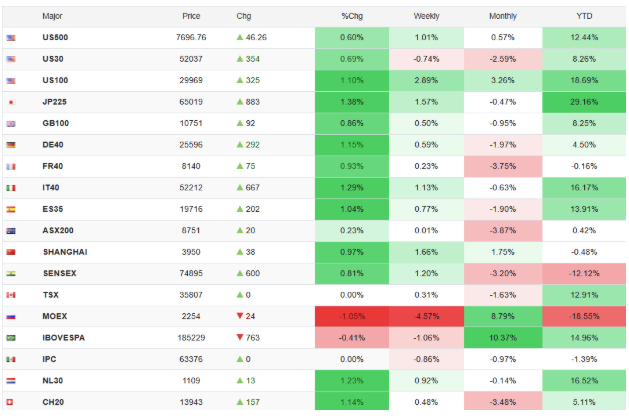
More trade. More raw materials. More energy. More investment. More demand for transportation. This is Growth Premium. And Then Come Interest Rates. The other major variable for markets lies in the bond market. The Federal Reserve recently raised its key interest rate by 25 basis points to 3.75%-4.00%. What is also interesting, however, is the reaction that followed: U.S. government bond yields declined, and equities recovered after the decision.
This reminds us of something particularly important. An interest-rate increase does not automatically mean the end of a bull market in equities. The real question is what happens to long-term interest rates, inflation and economic growth. The U.S. 10-year Treasury yield has moved close to the psychologically important 5% area, while TLT has returned to levels reminiscent of the intense pressure experienced by the bond market in October 2023.
That comparison is particularly interesting. In October 2023, the Fed Funds Rate stood at 5.25%-5.50%, significantly higher than today, while the 10-year Treasury yield had also approached 5%. And yet, that did not mark the end of the equity rally that followed. History never repeats itself in the same way and should never be used mechanically. But it reminds us that markets do not move solely on the absolute level of an interest rate. They also move in the direction of the next change.
Our view remains that the U.S. 10-year Treasury yield could move back toward the lower levels recorded in July. If that happens while economic activity remains resilient, the implications for valuations could be significant. Lower long-term yields mean a lower discount rate for future corporate earnings, more favorable financing conditions and greater potential for market gains to broaden beyond the relatively small group of stocks that have dominated performance so far.
The next upward move in markets does not necessarily have to be driven exclusively by the technology companies that led the previous wave. Transportation, industrials, infrastructure, value companies and selected areas of shipping could play a greater role if long-term yields stabilize and expectations for the global economy improve. Attention should be paid to Transportation. When goods are produced, moved and consumed, transportation ultimately participates.
A sustained strengthening of Transportation alongside the broader market would therefore be an important indication that the rally is broadening and moving from narrow stock-market leadership toward a wider economic cycle. And shipping naturally fits into this picture. And Here We Return to Malta. If the Mediterranean is becoming increasingly important for global energy flows, maritime transportation, logistics and the strategic relationship between Europe, North Africa and the Middle East, then Malta’s geographical position becomes even more valuable.
Its importance does not arise solely from its ship registry or its already well-developed maritime industry. It comes from the fact that Malta sits at the intersection of several of the forces reshaping the global economy: Energy security. Global trade. Shipping. Infrastructure. Capital flows. Geopolitics. The next shipping cycle will not be determined by freight rates alone.
It will be shaped by the interaction between trade, energy, interest rates, geopolitical agreements, infrastructure investment and the changing geography of global supply chains. New York this week may be a microcosm of this new reality. In the same city, Ukraine, Iran, Greenland, the Arctic, energy security and the world’s major geopolitical powers all converge.
And behind all of this ultimately lies the same investment question: Where will trade, energy and capital move when today’s geopolitical uncertainty begins to transform into a more predictable framework? For investors, understanding these connections is becoming increasingly important. The opportunities of the next cycle may not emerge where the consensus is looking today.
They may emerge in sectors and regions that for years have remained outside the center of investor attention. Shipping may be one of them. The Mediterranean may be another. And Malta, positioned between Europe, Africa and the Middle East, may find itself increasingly close to the center of both.
At a time when bond markets remain under pressure, geopolitical headlines dominate and investors continue to question the durability of the cycle, it is worth remembering something that markets have demonstrated many times before:
The good news may be much closer than markets are currently pricing in.
By George Kotsiakis