


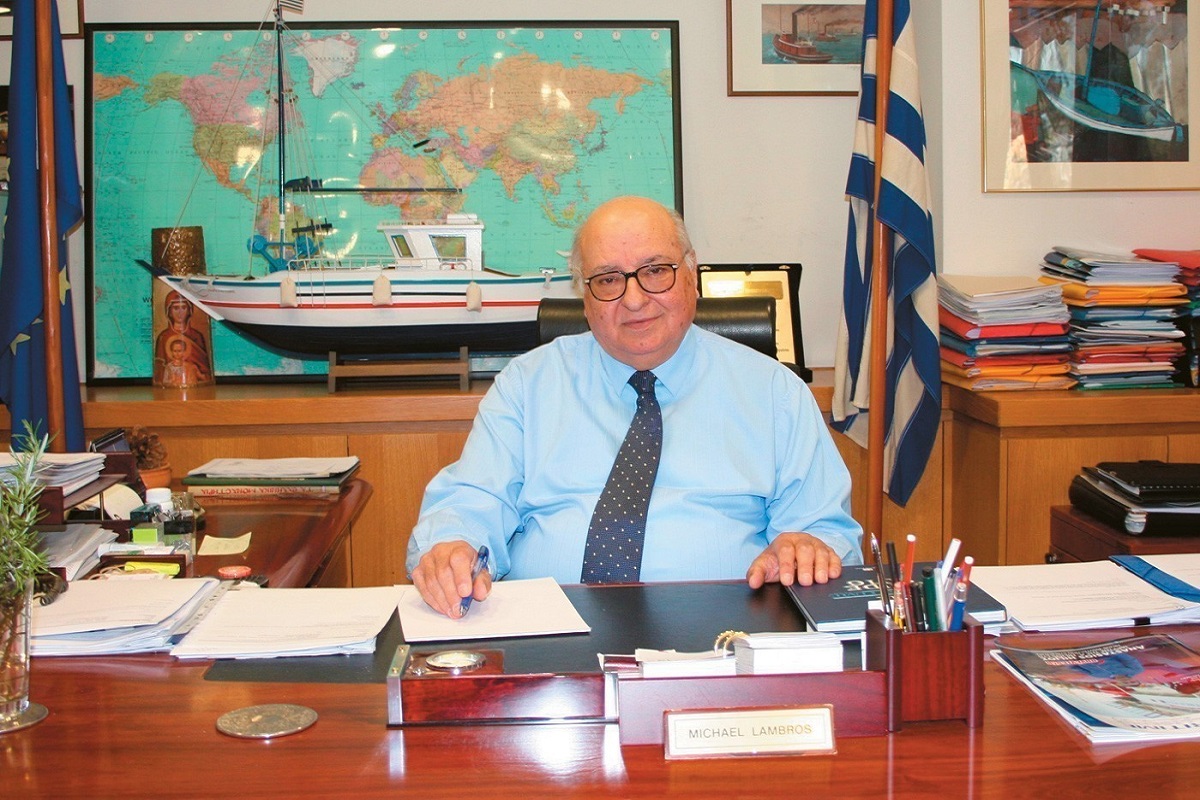
By Michael Lambros, Managing Director Majestic International Cruises Inc.
A serious problem faced by Greek and Greek-owned Shipping Companies concerns the lack of Greek seafarers to crew the ships, which is becoming more serious day by day due to the rapid increase in orders for new shipbuilding.
The older generation among us knew about the operation of Private Nautical Schools for the Training of young men and women during the 1960s, 1970s, and 1980s, all certified by the Ministry of Shipping. Private Nautical Schools operated in all specialties except the Public Schools and included students from all branches of the Shipping Industry. There were schools for Sailors, Electricians, Stewards, Cooks, etc., which were funded by Greek Shipowners. I experienced intensely the schools founded and maintained by the late Antonis Chandris in my hometown, Chios, as well as in Piraeus.
Personally, I had the honor of teaching at the Stewards School, which initially operated at the Ionideios School in Piraeus in the afternoons, and later in private facilities of the Stewards Association in Palaio Faliro.
Graduates of all these private schools, together with graduates of public schools, formed the backbone of the crews of Greek and Greek-owned ships, and particularly the crews of the coastal shipping and the large ocean liners of the CHANDRIS company operating on the Europe - Greece - Australia route.
In this way, during the decades I mentioned above, we reached the point of having active Greek sailors in the range of 85,000-90,000 without any unemployed personnel. Of course, at that time there were no foreign sailors available and the wage differences between Greeks and foreigners were not as large as they are today. At that time, Greek sailors 90,000-. Filipinos just 20,000-25,000. Today Greeks 20,000-, Filipinos almost 500,000-.
According to recent statistics, there are 2,000,000 seafarers worldwide, most of whom serve on coastal shipping and cruise ships. Greeks, who control 20% of the world’s ship capacity, control only 1% of seafarers.
It is a pleasant fact that, according to NAT data, in the year 2024, 2048 Greek female seafarers were serving on Greek and Greek-owned ships, representing 7.8% of the registered seafarers in NAT, while globally the percentage of female seafarers is 1%.
Governments after year 1980 gradually managed to abolish all Private Maritime Schools and, at the same time, weaken the Public Schools. In this way, we have reached the disappointing number of active Greek seafarers in the range of 18,000-20,000, of whom at least 5,000 are permanently unemployed, especially those belonging to the ranks of hotel specialties.
Today there are Greek shipowners who are interested in establishing Private Maritime Education Schools, such as the honorable Captain Panagiotis Tsakos, who recently founded a Private Maritime Academy in Chios. But what is the current situation on this very important issue of our Shipping?
We congratulate the efforts of the Ministry of Shipping and Island Policy to support public maritime education schools by increasing the number of incoming students in the year 2024/2025 to 1,507 compared to the year 2023 and for the year 2025/2026 to 1,559; however, this number is not sufficient to meet the needs of Greek crews on Greek and Greek-owned ships, the number of which has been rapidly increasing in recent years with new orders.
According to responsible statistics from the Council of Maritime Education in March 2024, a significant number of students attending Maritime Education schools discontinue their studies and leave the schools, resulting in graduates not meeting the increasing staffing needs of Greek and Greek-owned ships. We are, of course, referring to students of the Captain and Engineer Schools.
At the same time, a significant gap is recorded, mainly in Coastal Shipping, in the lack of ranks of lower crew specialties.
The efforts of the Ministry of Shipping and Island Policy, of the Eugenides Foundation, which every year publishes books of maritime content for the students of the public maritime education schools operating in Greece, are commendable in this field, but the 1,507 or 1,559 are not sufficient to meet the needs of the shipowners, and they are de facto forced to hire sailors from foreign schools, such as those in Varna and Cyprus, or to establish and finance private maritime schools in India, Indonesia, the Philippines, etc., from where they select the sailors who man their ships.
The International Chamber of Shipping predicts that there is a serious shortage of labor in the global shipping industry, particularly in the sector of officers, and forecasts that an additional 90,000 officers will be required to meet the needs by the year 2028. A large proportion of the shortages concerns Greek and Greek-owned ships.
If we really want to increase the number of young men and women entering the naval profession, why doesn’t the Ministry, in collaboration with shipping associations and the Eugenides Foundation, create a small committee for naval education that would visit middle and high schools nationwide and attract students? Why aren’t the advantages of working as a sailor promoted on television channels or in the broader daily press and magazines, something that would certainly attract young men and women to a satisfactory degree?
The maritime tradition of our country, the advantages of the naval profession, the consistently confirmed quality of work on ships, as well as the increasing strengthening of Greek and Greece-owned shipping at a global level, are elements that must be continuously promoted to attract new men and women to the naval field. It is also known to everyone that the naval profession offers secure employment with high salaries and positive prospects for daily improvement.
The Ministries and the competent authorities must proceed as soon as possible with the establishment and strengthening of private Maritime Education schools, following the model of the past.
I would like to emphasize that in 2014, the then Minister of Shipping and the Aegean, Mr. Miltiadis Varvitsiotis, after meetings with the Shipping Associations, stated that the establishment of private maritime schools was being planned. Mr. Varvitsiotis believed that the increase in Greek seafarers could only be achieved through the establishment of private maritime education schools. Unfortunately, this statement by Mr. Varvitsiotis remained in the Ministry’s drawers under subsequent Ministers of Shipping.
If there is indeed serious interest in bringing the number of Greek sailors back to the figures of the past, the competent authorities will have to take initiatives and ignore the negative interventions of irresponsible third parties.